
PVNet’s Low-Earth Orbit Satellite Tracking Project Brings STEM to Life By Sarah Wizemann

“I’m bored,” my daughter said. Her big brown eyes glazed over as her thumb scrolled and scrolled, tuning out this reality in favor of the one on the screen in front of her. But then something changed. Her eyes glimmered. “Check this out!” she said. “A rocket launch at SpaceX!” The transmission gave us chills. Space holds power. Even in our modern digital age, when every teenager spends the better part of their day hunched over a phone, lost in their digital experience, the thought of interacting with the aerospace community intrigues even the most indifferent of tweens. We can thank Neil deGrasse Tyson for making astrophysics cool again. Now imagine giving these kids the opportunity to work side by side with aerospace professionals and participate in a live mission, tracking satellites in real time.
In the coming months, something unprecedented will be happening on the roof of the Promenade PV Mall. A group of lucky middle and high school students will have the privilege of putting their phones down and getting their hands dirty, designing and building an operational satellite ground station. Guided by engineers and experienced professionals, they will construct a DIY satellite tracking station that will integrate with the worldwide SATNogs network, tracking real satellites in low Earth orbit.
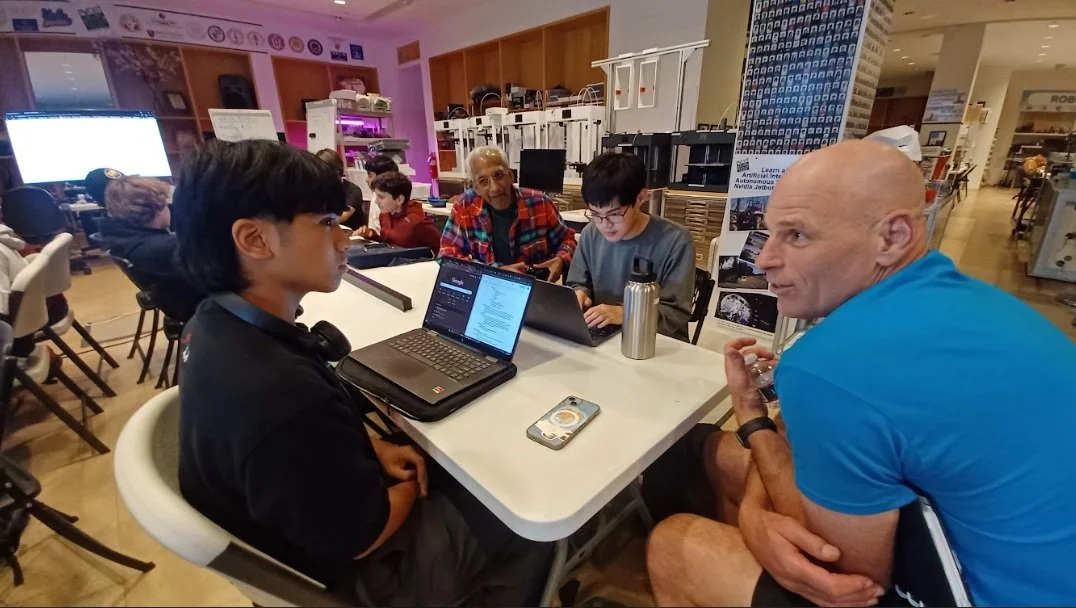
Student showing his conceptual component CAD design to David Goldstein and Madhu Thangavalu with Max looking on
It’s a common lament for parents and educators alike–how do we get our kids off their phones and out engaging with the real world, excited about learning? Well, here is the answer. It lies in project-based education, and few initiatives embody that approach better than PVNet’s new LEO program.
Madhu Thangavelu, a PV parent, university educator and longtime advocate for experiential learning, believes that abstraction is one of the public school system’s biggest obstacles. He feels that kids can’t absorb material through rote memorization alone. “It just doesn’t absorb,” he says. “There is no substitute on planet Earth for hands-on experience,” he explains. “Kids learn by interacting with real things. We have hands. Bodies. We need to touch things. When education becomes disconnected from physical experience, students lose something essential.”
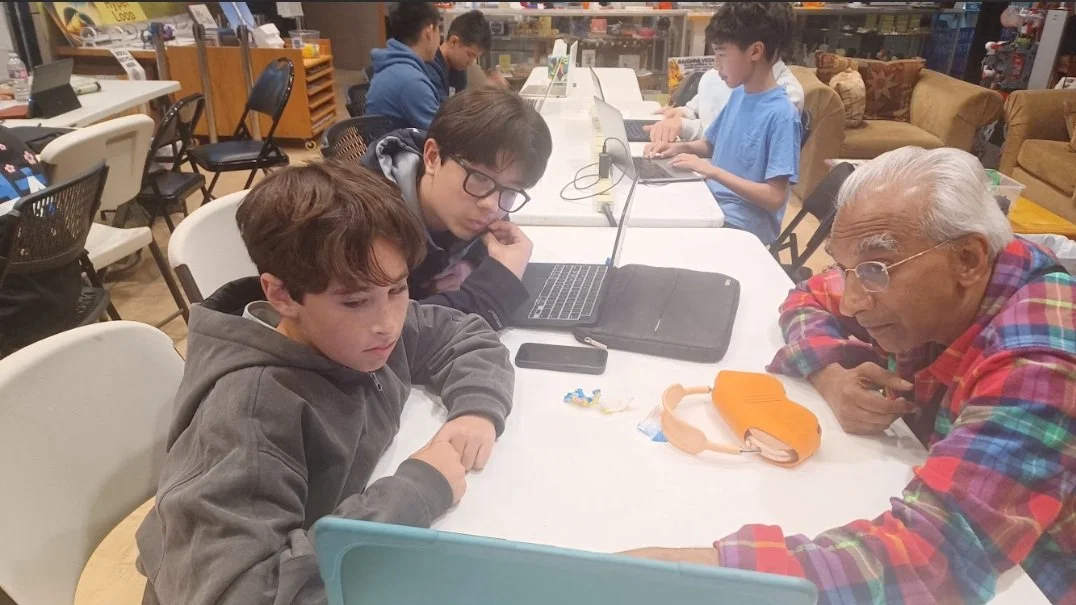
Madhu Thangavalu mentoring student in their aerospace designs
At PVNet, students don’t just read about systems — they build them. They invent, design, assemble hardware, write software, test signals, perform surgical procedures and even obtain provisional patents on their inventions. This heuristic approach allows students to discover concepts through exploration. And that’s the kind of knowledge that sticks.
This philosophy aligns with what industry leaders seek in new recruits. According to David Goldstein, a class mentor and SpaceX Engineer with over a decade of experience working on satellite systems, “The thing that we value most when hiring new engineers is hands-on experience – people who have built real systems, solved real problems and learned by doing.”
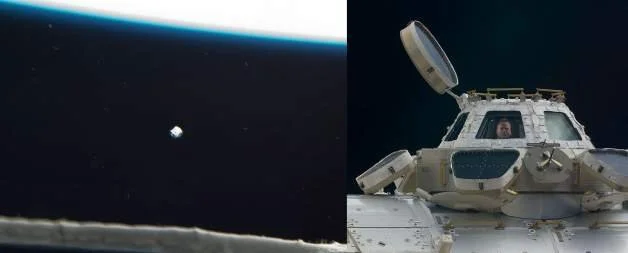
Example of life threatening damage which can be caused by objects in Low Earth Obit - Cupola-image damage MMOD
PvNet’s LEO project offers exactly that kind of learning experience, years before the students enter college. Low Earth Orbit satellites support communications, navigation, weather forecasting and scientific research. LEO satellites move rapidly across the sky, requiring active tracking and real-time problem solving.
Another aerospace and communications engineer and PV resident involved with the program agrees. “Students in sixth through ninth grade are learning fundamentals like math, physics and coding,” he says. “What PVNet does well is to give them a way to apply those fundamentals to something tangible. To be able to use this knowledge to communicate with the International Space Station–it’s pretty exciting!”

Example of type of SatNOGS open-source Satellite Networked Earth Tracking antenna students will build and deploy
“There are lots of satellites in space that don’t do a great job of telling you where they are, and not many worldwide tracking networks, so this is an amazing opportunity for students with an interest in space to actively participate in tracking them,” says Goldstein.
“Low Earth Orbit satellites move relative to the Earth, unlike geostationary satellites, which stay fixed over one position. That means tracking them requires different thinking–tracking antennas, understanding orbits, receiving signals as satellites pass overhead,” explains Madhu’s wife, Catherine, an electrical engineer with decades of experience designing satellite systems. “Just detecting and tracking real signals teaches them an enormous amount.”
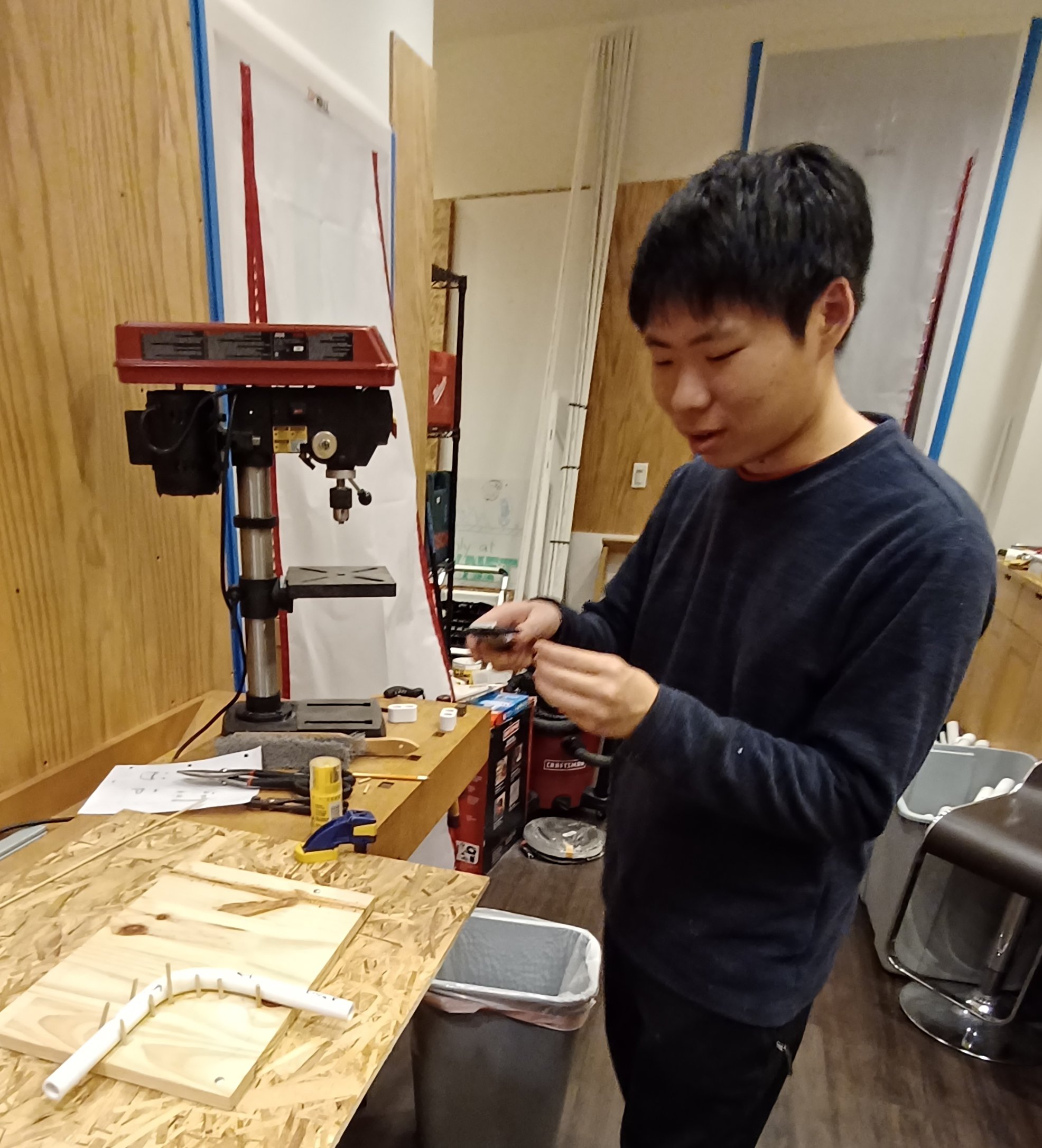
Student fabricating his design in the PVNet workshop
In the program, students see abstract equations turn into real data – learning how orbits work, how signals propagate and how ground stations lock onto moving targets. “This is real science,” Catherine says. “Real systems. Real signals.”
The program also introduces students to amateur ham radio, allowing them to work with licensed frequencies and communicate with the International Space Station. These skills directly translate to careers in aerospace, communications and engineering.
For Catherine, the value of programs like PVNet’s is personal. As the mother of three children, including a self-described “late bloomer” who studied at PVNet, she has seen how traditional education can overlook capable students who need a different approach to traditional education.
“He wasn’t failing,” she recalls of her youngest son. “The system just didn’t work for how he learned. Once he found motivation and a sense of purpose, everything changed.”
PVNet’s model doesn’t force students into a one-size-fits-all mold. Instead, instructors like Ted provide context, tools and vision, then give students the freedom to explore. “You don’t push every child to think the same way,” Madhu says. “That’s how creativity survives.”
Ultimately, PVNet’s LEO satellite project isn’t just about satellites. It’s about showing students that math and science matter, and that they are capable of working with complex, real-world systems. As Catherine puts it, “Children need space to think, to explore and to be curious.” PVNet is giving them that space – an infinite gift that keeps on giving.
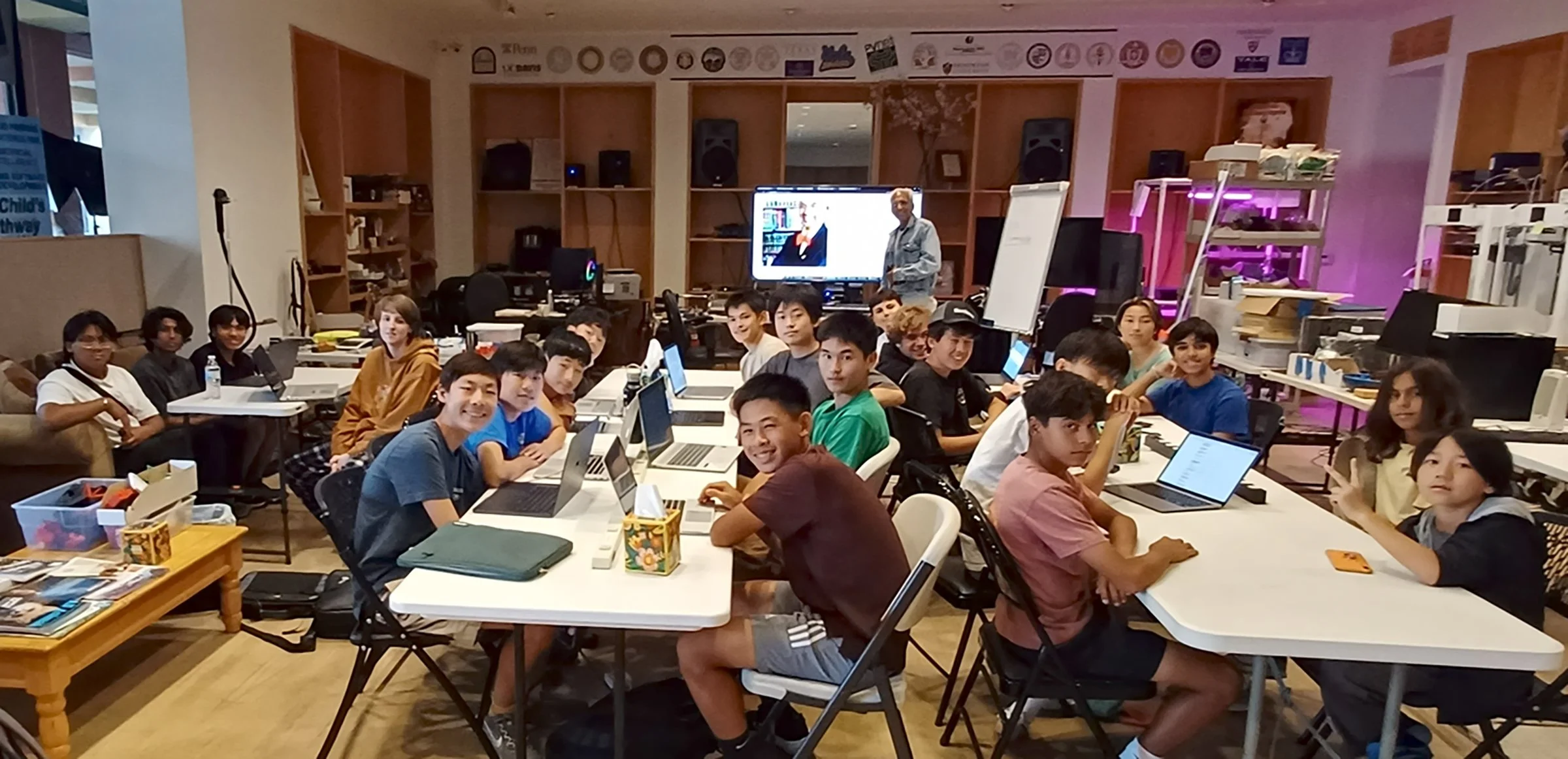
Students meeting to develop aerospace solutions
Sarah Wizemann is a writer, dancer and entrepreneur based in Palos Verdes. Sarah toured Russia as a teenage ballerina, obtained her BFA in Modern Dance, studied kabuki in Japan, started a non-profit arts organization in New York City, and owned a high-end lingerie boutique in Portland for 14 years. Her work has appeared in several of the Method Writers Speak anthologies by Jack Grapes. She is currently working on a novel.